The heat pump market is changing—not only in terms of volume, but also in its internal composition. The transition to environmentally friendly refrigerants is no longer just a theoretical discussion; it is the new reality of the industry. For distributors, project engineers, and installers, understanding this change today is a matter of business planning, not just another technical detail.
The Quiet Revolution That Is Transforming Air Conditioning
The European Union, through its F-Gas Regulation 2024/573, stipulated that as of January 1, 2027 Air-to-water heat pumps with a capacity of less than 50 kW may not use refrigerants with a Global Warming Potential (GWP) greater than 150. In practice, this removes from the European market refrigerants that are widely used today, such as the R410A (GWP 1,924) and the R32 (GWP 675).
Chile is a signatory to the Montreal Protocol and reaffirmed the Kigali Amendment in 2018, committing to a gradual reduction in the consumption of hydrofluorocarbons (HFCs). Although Chile’s deadlines are not yet as strict as those in Europe, the direction the industry is taking is clear: major manufacturers are transitioning their production lines to natural refrigerants, and in the coming years, the availability, price, and after-sales service for equipment using traditional refrigerants will be progressively affected.
For any project currently being designed—whether it’s a residential building, a condominium, a mining operation, or an industrial plant—the choice of refrigerant has long-term implications: for the availability of replacement parts, operating costs, and the confidence that can be instilled in the end customer.
The R290 is a natural refrigerant — refrigeration-grade propane. It is not a fluorinated gas, so it is completely exempt from the restrictions of the F-Gas Regulation and the quotas of the Kigali Amendment. Its GWP is barely 3, compared to 1,924 for R410A and 675 for R32. But the case for R290 isn't just about the environment. It's, above all, practical:
Superior thermal efficiency. The thermodynamic properties of propane allow for higher coefficients of performance (COP) across a wider temperature range. In practical terms: lower electricity consumption, higher-temperature domestic hot water (up to 70 °C) without relying on electric backup, and a concrete track record of energy savings to present to the customer.
Long-term availability. Because it is a natural substance, R290 is not subject to import quotas or speculative price fluctuations. Systems installed today are guaranteed to have service and availability in 10, 15, or 20 years.
Future regulatory alignment. Products built on R290 are already aligned with where the industry is headed. This means no future redesigns, no disruption to the product portfolio, and no awkward conversations with customers whose systems are still using discontinued refrigerants.
Safety by design. R290 is a flammable refrigerant, which requires careful engineering. The entire EnergySave R290 line uses monobloc architecture: The refrigerant circuit is factory-sealed within the outdoor unit and does not enter the home or building. This simplifies installation and completely eliminates any indoor risk.
Choosing a refrigerant for a project is a strategic decision. Specifying equipment that uses refrigerants subject to quota restrictions or future phase-downs introduces specific risks: supply uncertainty, price volatility, and the possibility of delivering systems that will be difficult to maintain in a few years.
An R290 line eliminates that risk. We’re delivering technology built around a refrigerant with a clear future, and that’s a message we convey with confidence to the end customer.
Thanks to its monobloc design, field work does not involve handling refrigerant: the circuit is factory-sealed. Installation simply involves connecting the water lines and power supply—without the certifications and procedures required for handling refrigerants on-site.
Furthermore, as traditional refrigerants become harder to obtain for after-sales service, having accumulated experience with R290 installations positions the installer to work with the technology that the industry is actually adopting.
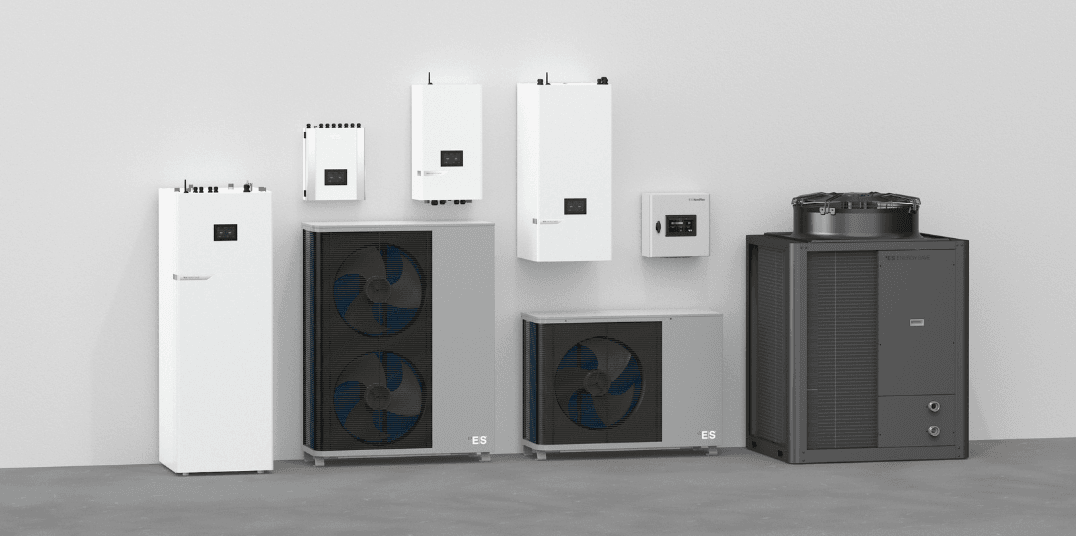
We offer a complete line of products for residential, commercial, and industrial applications—heating, cooling, and domestic hot water:
Residential Outdoor Units (R290 Series)
8 kW, 12 kW, and 15 kW models. Monobloc air-to-water heat pumps with an A+++ energy rating and Guaranteed operation down to -25 °C, ideal for the climate conditions of central-southern and southern Chile. Night mode for residential areas. The 8 kW and 12 kW models are available in single-phase configurations; the 15 kW model is available in both single-phase and three-phase configurations.
Integrated Indoor Units (Heatbox 100 L and 250 L Series)
Domestic hot water tank, backup heating element, and system controls integrated into a single unit. The 100-liter version is designed as a direct replacement for a gas boiler—same footprint, wall-mounted—for retrofit projects. The 250-liter model is suitable for medium and large homes with higher DHW demand. Both models include a touchscreen display, built-in connectivity, and control via a mobile app.
Indoor units without a reservoir (HydroBox and Control Box)
For hybrid systems where a hot water source already exists, or for heating-only applications. They integrate with existing electric, gas, wood, or pellet systems—ideal for retrofit projects that do not require replacing the entire system.
Commercial Solution (ES M40 R290 + NordFlex Controller)
40-kW commercial outdoor unit with R290, scalable in a cascade configuration of up to 16 units for larger-scale commercial and industrial applications. Certified with Keymark, providing access to European subsidy programs and international technical support.
All units in the R290 line include built-in connectivity and access to the fleet manager at no additional cost—remote monitoring, diagnostics, and alerts come standard. The residential line also features mobile app control for end users and over-the-air updates, enabling continuous improvements without the need for on-site visits.
The transition to R290 is not just a response to regulations—it is a strategic decision. At Scanditec, we are bringing to Chile the same R290 production line that EnergySave operates in Europe, with no modifications and no loss of quality. Swedish tradition applied to the Chilean landscape.
If you're evaluating heat pumps for a residential, commercial, or industrial project, let's discuss how the R290 line can meet your needs.